I remember the first college literary journal I ever saw. One of my friends brought it to me from Kenyon College. I was in high school. I opened it up to a poem about being drunk and thinking you were Jesus Christ. It was one of the milder poems.
I thought about that journal today when I opened up The Poets of the Future, a college literary anthology from 1917-1918.
"The stars are close tonight,/ Thoughts in the book of time; / Yet veiled unto my sight / The page sublime," a Dartmouth student wrote.
An Amherst gentleman said what he had to say in six lines: "Philosophy! A game, no more; yet such / As dwarfs all other games to nothingness, / That plays with aeons in its daring touch, / With stars for pawns, infinity to span. / Philosophy! A game for gods, no less, / That leaves man beaten, but a greater man."
Women were represented, of course, too. Here are a few lines from a somewhat self-absorbed Connecticut College student: "When clouds pass over the moon, / A thousand lurking shadows leer, / A thousand black-faced shadows peer, / From behind the trees and beside the wall and across the snow, / At me."
How did we change so much in 100 years? These poems are presumably what the students wanted to write. They were deservedly proud of them. I can't imagine one of these poems being accepted in one of today's college-sponsored literary journals. The language, the subjects........and I'm not even getting into the poems in this book that are so wildly politically incorrect that my eyes just skimmed the words in discomfort.
Well, that change--the change involving political correctness--I can understand. I witnessed the evolution of that sort of thing. But how did flowery, romantic language, once held in high esteem, reach a point of such disfavor? We don't have to go back 100 years, actually. Consider the lyrics of the hit songs of the 1950s. Could today's teens possibly embrace "Love is a Many Splendored Thing.....it's the April rose that only grows in the early spring" (1955)?
Or "Love and Marriage, love and marriage, go together like a horse and carriage" (1955)? Or how about "When the moon hits your eye like a big pizza pie, That's Amore" (1953)? There are better examples—I know this because the thought occurs to me often when I hear music from this period. It just doesn't seem within the realm of possibility that today's kids could find anything to relate to in those songs. Why is that? We're still human beings, with the same feelings, aren't we? Or are we evolving as a species more rapidly than I can comprehend?
I used to observe car-crazy young males and wonder what boys their age did in all those generations before the automobile was invented. I suppose the answer to that is they all lusted after bigger and faster horses.
By the way, guess which Yale University student is on p. 82.......Stephen Vincent Benet. "Poets of the Future" indeed.
Thursday, January 27, 2011

Friday, January 14, 2011
Another of My Medical Rants
I had a minor surgical procedure done on an outpatient basis yesterday. I had discussed anesthesia with my doctor, and agreed that they would use propofol. I've responded well to this in the past. I've been given Valium as a sedative before hospital procedures, but asked that they not administer it this time. I said I was fine, not anxious, and didn't need a sedative. I told him "I don't like altered states." The anesthesiologist said, "Okay, no Valium."
A few minutes later the nurse shot something into the port in my hand. "What's that?" I asked, and she said, "Versed." If there's one drug I have very strong feelings about, it's Versed. I hate it!! It's primarily a memory eraser, which I suppose explains why so many doctors and hospitals love it. The nurse said it's also a sedative, which is true. But I had already explained that I didn't need a sedative. Should I have said instead, "I don't want Valium, Versed, or any other benzodiazepine or tranquilizer"? Maybe I should have added, "I don't even want a martini!"
I was calm before the Versed, but seriously pissed off after. I didn't take it out on the nurses, who were all friendly and chatty, but I felt like a trapped animal. I knew I was going to remember what was happening only up to a certain point, after which it would be as though it never happened. Sure enough, when they wheeled me into the operating room and the nurses started asking me about the best position for my arthritic knees, I could feel myself slowly disappearing. I have a garbled memory of the beginning of that conversation, and then it's as though a black curtain descended on everything.
I've had Versed before. The first time it was given to me for a very painful procedure, and I woke up to find my shins skinned. "That's from when you tried to get away," the doctor said. I have no memory of the procedure, but my subconscious remembered: I had dreams where I was screaming.
The last time I had Versed, it took an uncomfortably long time for my memory to get back to normal. I've read that the older you are, the tougher it is to shake off the effects. I absolutely did not want to take it again.
Propofol is already a memory eraser. How much of my memory did they want erased, for heaven's sake?
I guess this is a warning. If there's something you don't want to swallow, breathe or take intravenously, be general as well as specific, and cover all your bases. With any luck, they might listen to you.
A few minutes later the nurse shot something into the port in my hand. "What's that?" I asked, and she said, "Versed." If there's one drug I have very strong feelings about, it's Versed. I hate it!! It's primarily a memory eraser, which I suppose explains why so many doctors and hospitals love it. The nurse said it's also a sedative, which is true. But I had already explained that I didn't need a sedative. Should I have said instead, "I don't want Valium, Versed, or any other benzodiazepine or tranquilizer"? Maybe I should have added, "I don't even want a martini!"
I was calm before the Versed, but seriously pissed off after. I didn't take it out on the nurses, who were all friendly and chatty, but I felt like a trapped animal. I knew I was going to remember what was happening only up to a certain point, after which it would be as though it never happened. Sure enough, when they wheeled me into the operating room and the nurses started asking me about the best position for my arthritic knees, I could feel myself slowly disappearing. I have a garbled memory of the beginning of that conversation, and then it's as though a black curtain descended on everything.
I've had Versed before. The first time it was given to me for a very painful procedure, and I woke up to find my shins skinned. "That's from when you tried to get away," the doctor said. I have no memory of the procedure, but my subconscious remembered: I had dreams where I was screaming.
The last time I had Versed, it took an uncomfortably long time for my memory to get back to normal. I've read that the older you are, the tougher it is to shake off the effects. I absolutely did not want to take it again.
Propofol is already a memory eraser. How much of my memory did they want erased, for heaven's sake?
I guess this is a warning. If there's something you don't want to swallow, breathe or take intravenously, be general as well as specific, and cover all your bases. With any luck, they might listen to you.
Wednesday, December 29, 2010
Eating Medicinally. Again.
"You eat medicinally!" a distant co-worker announced ten years ago, with the inflection of a scientist making an important but distasteful discovery.
He was right. I ate for the most basic of reasons: to fuel my body and improve my health. And, once I got past the carb cravings, I enjoyed eating that way. I liked my thinner self. I liked the way we can detect the sweetness in so many foods when we don't allow sugar to confuse our taste buds. Most of all, I liked knowing I was foiling the nasty combination of predispositions I'd inherited.
My family has a strong history of diabetes and heart disease. My paternal grandfather died of a heart attack at 61. My maternal grandmother died of a heart attack at 46. My theory—and I'll never be able to prove it—is that she had a tendency toward high triglycerides, and the German desserts she loved to bake were her undoing. I have the triglyceride problem, which can be a serious heart risk for women, and the only way to keep it in check is to severely limit carbohydrate consumption. They didn't know this, of course, in my grandmother's day.
I inherited something else, too: my dad's unusual fat-clearing (or, more accurately, fat retaining) gene. Well, I don't know if there's a specific gene for this, but it's the way I've always thought of it. Here's the story.
My father was 40 when I was born. He and my mom had met on the tennis courts, and he remained actively athletic until he was practically crippled by angina. This happened when I was quite young. I remember that he couldn't walk up a subway ramp without stopping to put a nitroglycerin tablet under his tongue. Any kind of exercise was out of the question. Back then nobody heard of cholesterol, but my dad's doctor was ahead of his time. He said saturated fat was the culprit, and advised my dad to give it up. All of it. No more cheese. No more ice cream, hot dogs, or juicy hamburgers. No more sausage. No more eggs. No more butter.
So he did. I grew up in a saturated-fat-free home, where polyunsaturated and cholesterol were household words. My dad stopped having angina pain, and was able to quit the nitroglycerin. He was able to start playing tennis again. He bought himself a bicycle, too. Over the years he found he could eat eggs without a problem. But if he ate fatty meat, or butter (this would usually happen at a restaurant), he would be in trouble the next day. Several times the resulting heart pains were strong enough to land him in the hospital.
For years he was told that it doesn't work like that. Cholesterol builds up gradually in the arteries; ingesting saturated fat doesn't clog them instantly. But in some people it can. A research study proved this a few years ago, but I had my own proof earlier than that.
It was about 20 years ago.....a cardiologist was preparing to perform a test in which my blood would be drawn and shaken in a test tube. When he shook the blood, he was appalled to find fat floating in it. He said he'd never seen anything like it. (And I think I just lost my more delicate readers.)
So. Whatever we want to call my father's odd fat metabolism, I share it. For that reason, and for the triglyceride issue, about 15 years ago I began eating medicinally. I got very strict with my diet, giving up saturated fats for one side of the family, and most carbohydrates for the other. It worked well for a good decade.
But at some point I started easing up on it. I was good about the fats, but I began allowing bread "if the restaurant is good and the bread is warm." Pasta once in a while. Some "whole grains," because they sound so healthy. That type of thing. But never, ever any sugar. And never ever any butter. Until the week before this Christmas.
My granddaughter and I had gotten together to bake cookies. I don't know what possessed me to taste them, but I did. I had just a few, but with cookies it doesn't take much. Cookies have got to be one of the most deliciously unhealthy things going. I had joked that our baking efforts were supporting the butter industry. And now some of that butter was coursing through my veins.
The next day I was standing in front of my washing machine, calmly folding laundry, when I experienced what felt like a dead-serious angina pain, traveling down the left side of my neck and into my chest. It was brief, but scary as hell. I've had little twinges where the arteries join the heart, but never anything like that. Being Harry's daughter, my first thought was, What did I eat? It took me a few minutes to remember the cookies of the day before. And then I remembered the goat cheese, of all things, from the day before that. Yes, I ate some of the goat cheese that a restaurant served with my lunch salad. I never do, but I did that day. Call it temporary insanity created by the merging of the Christmas season and my last day at work.
It was clear what had happened, and it was clear what I had to do. That day, three days before Christmas, I started eating medicinally. Again. As for all the foods I've had to turn down since then, I'll leave that to your imagination.
He was right. I ate for the most basic of reasons: to fuel my body and improve my health. And, once I got past the carb cravings, I enjoyed eating that way. I liked my thinner self. I liked the way we can detect the sweetness in so many foods when we don't allow sugar to confuse our taste buds. Most of all, I liked knowing I was foiling the nasty combination of predispositions I'd inherited.
My family has a strong history of diabetes and heart disease. My paternal grandfather died of a heart attack at 61. My maternal grandmother died of a heart attack at 46. My theory—and I'll never be able to prove it—is that she had a tendency toward high triglycerides, and the German desserts she loved to bake were her undoing. I have the triglyceride problem, which can be a serious heart risk for women, and the only way to keep it in check is to severely limit carbohydrate consumption. They didn't know this, of course, in my grandmother's day.
I inherited something else, too: my dad's unusual fat-clearing (or, more accurately, fat retaining) gene. Well, I don't know if there's a specific gene for this, but it's the way I've always thought of it. Here's the story.
My father was 40 when I was born. He and my mom had met on the tennis courts, and he remained actively athletic until he was practically crippled by angina. This happened when I was quite young. I remember that he couldn't walk up a subway ramp without stopping to put a nitroglycerin tablet under his tongue. Any kind of exercise was out of the question. Back then nobody heard of cholesterol, but my dad's doctor was ahead of his time. He said saturated fat was the culprit, and advised my dad to give it up. All of it. No more cheese. No more ice cream, hot dogs, or juicy hamburgers. No more sausage. No more eggs. No more butter.
So he did. I grew up in a saturated-fat-free home, where polyunsaturated and cholesterol were household words. My dad stopped having angina pain, and was able to quit the nitroglycerin. He was able to start playing tennis again. He bought himself a bicycle, too. Over the years he found he could eat eggs without a problem. But if he ate fatty meat, or butter (this would usually happen at a restaurant), he would be in trouble the next day. Several times the resulting heart pains were strong enough to land him in the hospital.
For years he was told that it doesn't work like that. Cholesterol builds up gradually in the arteries; ingesting saturated fat doesn't clog them instantly. But in some people it can. A research study proved this a few years ago, but I had my own proof earlier than that.
It was about 20 years ago.....a cardiologist was preparing to perform a test in which my blood would be drawn and shaken in a test tube. When he shook the blood, he was appalled to find fat floating in it. He said he'd never seen anything like it. (And I think I just lost my more delicate readers.)
So. Whatever we want to call my father's odd fat metabolism, I share it. For that reason, and for the triglyceride issue, about 15 years ago I began eating medicinally. I got very strict with my diet, giving up saturated fats for one side of the family, and most carbohydrates for the other. It worked well for a good decade.
But at some point I started easing up on it. I was good about the fats, but I began allowing bread "if the restaurant is good and the bread is warm." Pasta once in a while. Some "whole grains," because they sound so healthy. That type of thing. But never, ever any sugar. And never ever any butter. Until the week before this Christmas.
My granddaughter and I had gotten together to bake cookies. I don't know what possessed me to taste them, but I did. I had just a few, but with cookies it doesn't take much. Cookies have got to be one of the most deliciously unhealthy things going. I had joked that our baking efforts were supporting the butter industry. And now some of that butter was coursing through my veins.
The next day I was standing in front of my washing machine, calmly folding laundry, when I experienced what felt like a dead-serious angina pain, traveling down the left side of my neck and into my chest. It was brief, but scary as hell. I've had little twinges where the arteries join the heart, but never anything like that. Being Harry's daughter, my first thought was, What did I eat? It took me a few minutes to remember the cookies of the day before. And then I remembered the goat cheese, of all things, from the day before that. Yes, I ate some of the goat cheese that a restaurant served with my lunch salad. I never do, but I did that day. Call it temporary insanity created by the merging of the Christmas season and my last day at work.
It was clear what had happened, and it was clear what I had to do. That day, three days before Christmas, I started eating medicinally. Again. As for all the foods I've had to turn down since then, I'll leave that to your imagination.
Friday, December 24, 2010
Christmas Eve makes me think of cookies......
.......and this year all my cookie recipes came from the Internet. I often get recipes online, and I look for ones that have lots of stars in their reviews. I don't know why I do that, because so many of the positive reviews are written by people who made so many changes to the original recipe that the review ends up being useless.
Consider this 5-star review of a recipe for bran muffins--regular old plain (but yummy) bran muffins. I'm shaking my head. :-)
I omitted the sugar and the raisins to form a batter that I could then half. One for a savory and one for a banana chocolate chip nut muffin. For the savory I added finely chopped boiled brocoli 1 1/2 cups, added 1/4 cup dried onion flakes, finely chopped sun dried tomatoes, 1 tbsp feta cheese, 1 tbsp romano, 4 tbsp shredded cheddar, and oregano. This is now one of my favorite breakfasts on the go. For the sweet I added 1 mashed banana 1/4 cup dark mini chocolate chips, 2 tbsp maple syrup, 1/2 cup combined chopped walnuts, almonds and sunflower seeds.
Merry Christmas, everyone!! Here's wishing you a year filled with fun and good health—and not a speck of broccoli in your bran muffins.
Consider this 5-star review of a recipe for bran muffins--regular old plain (but yummy) bran muffins. I'm shaking my head. :-)
I omitted the sugar and the raisins to form a batter that I could then half. One for a savory and one for a banana chocolate chip nut muffin. For the savory I added finely chopped boiled brocoli 1 1/2 cups, added 1/4 cup dried onion flakes, finely chopped sun dried tomatoes, 1 tbsp feta cheese, 1 tbsp romano, 4 tbsp shredded cheddar, and oregano. This is now one of my favorite breakfasts on the go. For the sweet I added 1 mashed banana 1/4 cup dark mini chocolate chips, 2 tbsp maple syrup, 1/2 cup combined chopped walnuts, almonds and sunflower seeds.
Merry Christmas, everyone!! Here's wishing you a year filled with fun and good health—and not a speck of broccoli in your bran muffins.
Tuesday, December 07, 2010
This Time Six Years Ago.........
It's December, and we all know what that means. Rather than write about shopping, wrapping, mailing, decorating, and baking (which is all I can think about this month), I'm sharing something I ran across this morning. I wrote it at the end of my 2004 Christmas letter:
As I write this, two guys from my gas company are attempting to convert the new range from natural gas to LP. They’ve been attempting this for about two hours now. When they arrived they took one look at the stove and said they didn't have the right tool. It sounded like they needed some special screwdriver bit, so I got out the set I'd bought myself a couple of months ago and asked if one of those would do. One would.
But there were other obstacles, and the guy in charge opened the owner's manual to do his research…until I discovered that he was reading the one for the microwave. Now I'm sitting here writing to you, and they're hunched over the stove, saying things like, "If you lose that, we're dead." and "Now which one goes in here?" and "Oh, boy, do I hate engineering!" and "Which one is the big one?" and “We lost 30 minutes because you didn’t listen to me when I said I was right!” and “How’re we gonna figure this out?” and the worst: "I'm gonna stick a piece of paper in here" "I dunno...I don't like the idea of paper in the gas burner." It’s a remarkably good rendition of the Three Stooges, minus one.
A sense of humor is a great blessing.
As I write this, two guys from my gas company are attempting to convert the new range from natural gas to LP. They’ve been attempting this for about two hours now. When they arrived they took one look at the stove and said they didn't have the right tool. It sounded like they needed some special screwdriver bit, so I got out the set I'd bought myself a couple of months ago and asked if one of those would do. One would.
But there were other obstacles, and the guy in charge opened the owner's manual to do his research…until I discovered that he was reading the one for the microwave. Now I'm sitting here writing to you, and they're hunched over the stove, saying things like, "If you lose that, we're dead." and "Now which one goes in here?" and "Oh, boy, do I hate engineering!" and "Which one is the big one?" and “We lost 30 minutes because you didn’t listen to me when I said I was right!” and “How’re we gonna figure this out?” and the worst: "I'm gonna stick a piece of paper in here" "I dunno...I don't like the idea of paper in the gas burner." It’s a remarkably good rendition of the Three Stooges, minus one.
A sense of humor is a great blessing.
Tuesday, November 23, 2010
These Are My "After" Pictures


I actually took these pictures an hour before a small party I gave last week, but I call them my "after" pictures because it took years to get my house to this point.
I'm not showing you any "before" pictures. At some point I realized that the state of my house almost always reflected the state of my mind. If that's true—and I think it is—my mind was in complete disarray for a long time. That's not hard to believe.
Adding to the emotional issues was The Remodel. Even the happiest people report difficulty surviving a remodel. The decisions! The intrusion! The mess! Although I have to say the mess didn't bother me. I already had a mess. I viewed the remodel as a way out of the mess. And it was. But for over a year we moved stuff from one room to another, clearing areas to be worked on, while I tried to keep the cats from escaping out doors that were left open for the contractor and his crew to go back and forth.
When it was all done I was still left with a living room full of things that didn't belong there, some of them rather large—like the bed that belonged in the guest room upstairs. I was also missing a few things. I had paid a furniture-maker in advance for the pieces I ordered. He delivered some, but not all, and was never heard from again.
It took a long time to sort through everything and put together a decent living space. My lack of decorating confidence certainly didn't help, and I don't know whether it's harder or easier to have to make all the decisions alone. (Shell White paint? Petal White? White Swan? Mirror here? Mirror too high? Too low? Eeek!) As I've said so many times, thank heavens for the Internet. In this case, thank heavens for the home forums at GardenWeb. I didn't always agree with the decorating, kitchen-designing mavens, but seeing photos of their homes, and reading their discussions, helped me clarify my thinking.
This year clutter started building up. Nothing like years past, but it was one more indication that I needed to do some evaluating. After a lot of thought I realized that the job I've held for two years was dragging me down. Not the job itself, which is pleasant and not demanding, but the isolation of being the only staff member present at night—and the nasty, mountainous, circuitous 45-minute drive home in the dark. I realized I had to move on, and I needed more contact with people.
So I took what felt like two bold steps: I gave notice at work, and I sent an invitation to a dozen or so friends, inviting them to come sing with me at my piano. This is something Jill and I used to organize at Christmas, but I hadn't hosted it—or done any other kind of entertaining—in over a decade. It turned out so well. It gave me the push I needed to get the house in shape for visitors, and the gathering itself was great fun.
Ah, chaos. I don't miss it. I have no doubt it will come creeping back to one degree or another, but I'm on guard and I have a plan. Starting in January or February, friends here to play games. And another songfest in spring, before I give up housekeeping once again to turn my attention to the garden.
Oh, okay.....here's one during-the-party pic. My kitchen is not yellow, BTW. (Not that I have anything against yellow kitchens!)

Sunday, November 07, 2010
So much traffic on those airwaves........
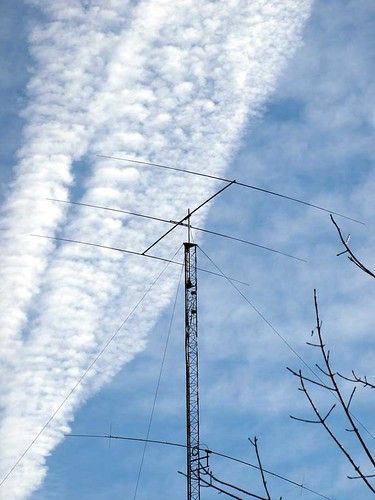
.......but we can't see it. My son can hear a lot of it, though. This weekend he talked to people in Greenland, Spain, Saudi Arabia, Belgium, Italy, South Africa, Svalbard (in the Arctic, off Norway), the Canary Islands, Germany, Scotland, Cuba, Romania, Austria, and Greece. Gotta love ham radio!
Sunday, October 24, 2010
Thanks for the Push.

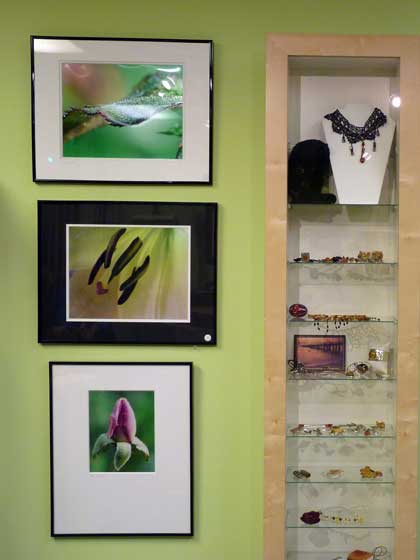
I went through my blog the other day, reading over many of the old posts, and found a number of comments urging me to exhibit my photos. Thanks to your encouragement, and that of other friends, I began showing my camera work last year, doing two exhibits. This year I've had three. The one running now opened on Friday, and we had a great time at the reception.
The show is at a beautiful shop selling amber jewelry from Poland (and online, too), by the way.
Oh, and check out the way they hung the oil-on-water pictures (and Lizzie's eye)!
My sincere thanks to those who urged me to "put it out there." (In a manner of speaking.)
Monday, October 11, 2010
The Elopers Have Been Partying!!

The bride's family threw a party (I guess we can call it a wedding reception) Saturday night for the beautiful couple who dared to elope in August. It was a wonderful gathering—and now I can officially think of my son as a Married Man. (Yikes!)
Thursday, October 07, 2010
Annie has been organizing!

This is Annie. It hasn't been easy persuading her and her son Pogo to be indoors full-time (after all, they started out in my neighbor's barn), but we've been doing pretty well since spring.
Maybe Annie's been a little bored in the house. Or perhaps she has strong organizational instincts. But whatever the reason, she has been on a mission that good housekeepers (and others, like me) can appreciate. She has searched the house for Wolfy's leftover dog toys and carted them one by one upstairs, depositing them outside my bedroom door. Wolfy was a big dog, and some of these toys seem awfully heavy and/or awkward for a small cat, but Annie managed somehow. Then a few days later she gathered up all the cat toys and set them together just inside the front door.
With her mission accomplished, I figured she could use something new to occupy her, so yesterday I bought one of those laser lights for cats ($4 at Walmart). What a big success!! I can see both my cats are going to be well exercised (for a change).
Now if only someone could interest me in running back and forth and around in circles after a laser light.....
Monday, October 04, 2010
Fifteen two, four, six.........
If that title means anything at all to you, you've played cribbage. My dad was taught to play cribbage by a hospital roommate many decades ago, and that was the start of countless games between the two of us. We loved our cribbage games so much that one year I bought him a giant cribbage board, four feet long. Because he lived in Florida, mud-daubing wasps filled up all the holes. But I cleaned them out, and I still have the board somewhere. I should find it and hang it up.
This week I discovered online cribbage, playing against the computer. Believe me, it is not as much fun as playing with Harry. But I was surprised at how quickly the game came back to me, considering it's probably been close to 20 years since I've played. And I learned something else. There's a certain lingo attached to cribbage, and after I played a few rounds with the computer I began to remember it. It felt good to speak it aloud.
"See one, play one."
"Fifteen four is all I score."
I don't know why cards are so much fun. How we found hilarity in sitting at a table staring at them and adding up points, I have no idea. But we did. The banter was fast and funny, our laughter frequent.
My dad loved playing cards. If we had a group, we played knock rummy. If it was just the two of us, we played cribbage, honeymoon bridge, or some variation on rummy. And you had to play for money with my father. Not a lot of money, but some coins had to exchange hands at the end of the evening. Said coins usually ended up in his hand.
My daughter Jill was the only one of my kids to inherit the card gene. She and I played several different games, but it is our hilarious double-solitaire battles I remember best. No money was involved, but you'd think we were playing for megabucks the way our hands slammed those cards down to beat the other to the center. Like her grandfather, she usually beat me.
Playing against a computer really can't compare. No matter how many qualities one tries to attribute to one's opponent, it's just a hunk of metal. And the charming British accent of the recorded scorekeeper fails to save the experience from being so quiet. Maybe this is why I find myself saying out loud all those expressions my dad taught me so long ago.
"Fifteen two is all I do."
This week I discovered online cribbage, playing against the computer. Believe me, it is not as much fun as playing with Harry. But I was surprised at how quickly the game came back to me, considering it's probably been close to 20 years since I've played. And I learned something else. There's a certain lingo attached to cribbage, and after I played a few rounds with the computer I began to remember it. It felt good to speak it aloud.
"See one, play one."
"Fifteen four is all I score."
I don't know why cards are so much fun. How we found hilarity in sitting at a table staring at them and adding up points, I have no idea. But we did. The banter was fast and funny, our laughter frequent.
My dad loved playing cards. If we had a group, we played knock rummy. If it was just the two of us, we played cribbage, honeymoon bridge, or some variation on rummy. And you had to play for money with my father. Not a lot of money, but some coins had to exchange hands at the end of the evening. Said coins usually ended up in his hand.
My daughter Jill was the only one of my kids to inherit the card gene. She and I played several different games, but it is our hilarious double-solitaire battles I remember best. No money was involved, but you'd think we were playing for megabucks the way our hands slammed those cards down to beat the other to the center. Like her grandfather, she usually beat me.
Playing against a computer really can't compare. No matter how many qualities one tries to attribute to one's opponent, it's just a hunk of metal. And the charming British accent of the recorded scorekeeper fails to save the experience from being so quiet. Maybe this is why I find myself saying out loud all those expressions my dad taught me so long ago.
"Fifteen two is all I do."
Saturday, September 04, 2010
Old Stones, Old Lives

I've been spending a lot of time in old cemeteries, photographing gravestones as a volunteer for FindAGrave. I went to this one, in the photograph, yesterday. Here I found a stone that read George, son of Charles and Mary Daniels, born Mar. 25, 1845
DROWNED
in the Narrows of Lackawaxen on Friday the 11th day of October 1861 his body was found in the Delaware River at Cars Rock on Sunday Oct. the 20, 1861. Aged 16 years, 7 mo. & 14 days.
I couldn't read all of the bottom inscription, but I made out the following, and I think we understand, without words, the rest.
From the beautiful world tis lived for parents and children
. . . . . to part . . . .
O may we meet . . . .
Where parting shall be no more
I have long accepted, if not exactly embraced, the premise that we live until we fulfill whatever it is we're supposed to accomplish on this earth, but the more trips I make to old cemeteries, the harder it is to hang on to that concept. In the 19th Century, so many died so young. Childbirth back then was risky business; you see the evidence of that on the gravestones of all the young wives. And the children! An epidemic would sweep through an area and take a good percentage of the young with it.
Some of the tales told on the gravestones are heartbreaking, like the family who, in 1878, lost a son named Earley, not quite two years old, on May 24; a nine-year-old daughter, Ann, on May 28; and on June 4 little Samuel who had turned four nine days earlier. Then, seven years later, they lost two-and-a-half-year-old Dessie.
The parents of George, above, might have breathed a little easier having gotten their son to the ripe old age of 16—until the unthinkable happened, and he drowned.
I remind myself that the 19th Century doesn't have a monopoly on tragedy. Those multiple deaths could be happening right now in other parts of the world. And it was unthinkable when a friend's son (and good friend of my daughter Gillian's) drowned in Lake Champlain two years ago—on the same day he was his sister's Man of Honor at her wedding.
I guess it's not for us to know what purpose anyone's life might have served, or be serving still. We can only assume that Samuel and Dessie and the rest got it right. And hope that in the end we will have gotten it right, too.
Wednesday, September 01, 2010
What do you make of coincidence?
I often say I don't believe in coincidence. That is, when two things happen, seemingly coincidentally, I usually attribute some sort of significance to it. There's a message in there somewhere.
Well, I haven't figured out the most recent message I received, but it was impossible not to notice it.
At work yesterday I filled a request to send out a number of books. One of them was Gangrene and Glory, a history of medical care during the Civil War. I thought that sounded interesting, and although I had no time to sit down with it, I opened the book at random before I scanned the bar code. It opened to an account of General Stonewall Jackson, mortally wounded, being examined by his physician, Dr. Hunter McGuire.
It was rather fascinating, but I didn't have time to read on. So I scanned the book and packed it up with the others. Then I got my salad out of the fridge and grabbed a copy of The New Yorker to read while I ate.
I opened the magazine, and the first thing I read was a letter to the editor by the great-great grandson of Dr. Hunter McGuire. The letter was about the death of General Stonewall Jackson.
How often do I think of Stonewall Jackson? Do I ever think about Stonewall Jackson?
I do now.
Well, I haven't figured out the most recent message I received, but it was impossible not to notice it.
At work yesterday I filled a request to send out a number of books. One of them was Gangrene and Glory, a history of medical care during the Civil War. I thought that sounded interesting, and although I had no time to sit down with it, I opened the book at random before I scanned the bar code. It opened to an account of General Stonewall Jackson, mortally wounded, being examined by his physician, Dr. Hunter McGuire.
It was rather fascinating, but I didn't have time to read on. So I scanned the book and packed it up with the others. Then I got my salad out of the fridge and grabbed a copy of The New Yorker to read while I ate.
I opened the magazine, and the first thing I read was a letter to the editor by the great-great grandson of Dr. Hunter McGuire. The letter was about the death of General Stonewall Jackson.
How often do I think of Stonewall Jackson? Do I ever think about Stonewall Jackson?
I do now.
Tuesday, August 31, 2010
Eleven In¢hes!

A lot of considerate folks have been leaving comments on my blog concerning peni$ enlargement. Perhaps this explains the size of the beans I've been harvesting this year.
Monday, August 16, 2010
Bean Excitement!
Over the years I've devised some pretty feeble methods of growing pole beans. I guess the most memorable was my Rube Goldberg-like nest of tomato cages, which had to be tethered to the house and a radio tower. Last year's effort, a curtain of beans, was prettier, but the yield was almost non-existent.
This year I have nailed it (almost literally)!! Checking out a message thread entitled "Show Me Your Trellis" on GardenWeb, I saw the bean support of my dreams: a 16-ft. cattle panel (I had never heard of a cattle panel) bent to make an 8-ft. tall arch. The base was secured with posts driven into the ground. The whole thing cost less than $35. The bean arch met all my criteria for the perfect support; it was homemade, easy, permanent, and cheap. I was in love.
I borrowed my son's pick-up and set out in search of a cattle panel, which turned out to be surprisingly easy to find. It was only slightly more difficult to persuade my son to set it up for me. ("Homemade" and "easy" are relative terms.) Once he did, I planted my beans: Kentucky Wonders, which my family has always loved, and Fortex, which the bean people on GardenWeb rave about all the time.
It was exciting to see the seedlings emerge, and even more fun when they got tall enough to start climbing. I can walk under the arch, and I'm so looking forward to reaching up to pick handfuls of beans.
I chose the terrace to set it up because (so far) deer don't walk there. Apparently a woodchuck does, though . . . the lettuce I planted in a big bin got eaten the other night. Also growing in containers on the terrace are cucumbers and beets. Oh, and two containers of pole beans, which are climbing up my son's radio tower. When I thinned the plants growing by the arch, I couldn't bear to throw away those thinnings. They had tried so hard to produce their beautiful, strong root systems. (Can you tell I anthropomorphize everything?)

This year I have nailed it (almost literally)!! Checking out a message thread entitled "Show Me Your Trellis" on GardenWeb, I saw the bean support of my dreams: a 16-ft. cattle panel (I had never heard of a cattle panel) bent to make an 8-ft. tall arch. The base was secured with posts driven into the ground. The whole thing cost less than $35. The bean arch met all my criteria for the perfect support; it was homemade, easy, permanent, and cheap. I was in love.
I borrowed my son's pick-up and set out in search of a cattle panel, which turned out to be surprisingly easy to find. It was only slightly more difficult to persuade my son to set it up for me. ("Homemade" and "easy" are relative terms.) Once he did, I planted my beans: Kentucky Wonders, which my family has always loved, and Fortex, which the bean people on GardenWeb rave about all the time.
It was exciting to see the seedlings emerge, and even more fun when they got tall enough to start climbing. I can walk under the arch, and I'm so looking forward to reaching up to pick handfuls of beans.
I chose the terrace to set it up because (so far) deer don't walk there. Apparently a woodchuck does, though . . . the lettuce I planted in a big bin got eaten the other night. Also growing in containers on the terrace are cucumbers and beets. Oh, and two containers of pole beans, which are climbing up my son's radio tower. When I thinned the plants growing by the arch, I couldn't bear to throw away those thinnings. They had tried so hard to produce their beautiful, strong root systems. (Can you tell I anthropomorphize everything?)
Friday, August 13, 2010
Intentionally Bad Poem
This morning I was reminded of a poem I wrote for a Bad Poetry challenge issued by my online writing group a number of years ago. Whenever I run across it, I still laugh.
To My Soulmate
When I saw you walk into the room
Well it wasn’t the room I was in or anything
But it was like through the hallway, you know,
That I saw you,
And I knew.
I just knew.
My heart it like opened.
And you walked in.
Just like how you walked into the room.
Not the room I was in,
But the other room.
To My Soulmate
When I saw you walk into the room
Well it wasn’t the room I was in or anything
But it was like through the hallway, you know,
That I saw you,
And I knew.
I just knew.
My heart it like opened.
And you walked in.
Just like how you walked into the room.
Not the room I was in,
But the other room.
Saturday, August 07, 2010
Blacker-Than-Black Humor
One day a couple of years ago I called the veterinarian's office:
Hello, I’m calling to inquire about cremation options . . .
Aha! Amazingly, you’ve got the right person. I do the cremations. I don’t usually answer the phone, but the girls aren't at the desk (where do you suppose they could be? it's not lunch time) and I was standing nearby, filling out some forms, so here I am.
Oh. Well, perhaps you can give me some information. I have two elderly dogs . . .
You know, I have two Afghan hounds, Liberace and Barbra. They were from the same litter, and they are both 12 years old. But one of them acts much younger than the other. It's really amazing to watch. Like the other day Liberace . . .
Right. My dogs are 13 and 15, and I was wondering . . .
I’m sure if you’re calling about two dogs you love, you’ll want their ashes back.
Well, yes, that’s what I was . . .
Then you won’t want the Group Cremation. That’s with . . . a group. I offer what I call a Semi-Private cremation, with one dog at the back of the chamber and one in front. It’s not guaranteed to be “pure,” if you know what I mean. Depends a lot on the size of the dog. How much do your dogs weigh?
Um . . . they’re fairly large—about 65 to 70 pounds.
Hmmm…….yes, I think you’ll want to go with the Private Cremation. For that, we charge $195 . . . no, $160 . . . no, $140.
Okay. Well, thank you very much. I’ll be . . .
I also want to offer you something else. I don't offer this to just anyone, mostly because most people don’t want it, but you have a nice voice and maybe you will. If you like, I’ll be glad to show you the equipment and the process, start to finish. How does that sound?
No!! I mean, no, thanks. Add me to the list of people who turn down your offer, but thanks anyway.
Well, I’m in this business because I feel I’m doing something for the pets. I wouldn’t stay in this job if I felt otherwise. I’m sensitive to it, you know what I mean? I want you to know you’re doing the right thing for your dogs. I don’t know if you have any loved ones who have been cremated . . .
Um . . . yes?
Well, I’ve seen crematoriums for humans that aren’t up to my standards.
Mmmm.
I heard that a local funeral home is going to be offering pet cremation. I was going to call them about offering my services, but I don’t know if they even have an oven yet . . .
I really have to go. Thanks so much for the information.
Alrighty then. I hope we don’t see you any time soon! (chuckle, chuckle)
Hello, I’m calling to inquire about cremation options . . .
Aha! Amazingly, you’ve got the right person. I do the cremations. I don’t usually answer the phone, but the girls aren't at the desk (where do you suppose they could be? it's not lunch time) and I was standing nearby, filling out some forms, so here I am.
Oh. Well, perhaps you can give me some information. I have two elderly dogs . . .
You know, I have two Afghan hounds, Liberace and Barbra. They were from the same litter, and they are both 12 years old. But one of them acts much younger than the other. It's really amazing to watch. Like the other day Liberace . . .
Right. My dogs are 13 and 15, and I was wondering . . .
I’m sure if you’re calling about two dogs you love, you’ll want their ashes back.
Well, yes, that’s what I was . . .
Then you won’t want the Group Cremation. That’s with . . . a group. I offer what I call a Semi-Private cremation, with one dog at the back of the chamber and one in front. It’s not guaranteed to be “pure,” if you know what I mean. Depends a lot on the size of the dog. How much do your dogs weigh?
Um . . . they’re fairly large—about 65 to 70 pounds.
Hmmm…….yes, I think you’ll want to go with the Private Cremation. For that, we charge $195 . . . no, $160 . . . no, $140.
Okay. Well, thank you very much. I’ll be . . .
I also want to offer you something else. I don't offer this to just anyone, mostly because most people don’t want it, but you have a nice voice and maybe you will. If you like, I’ll be glad to show you the equipment and the process, start to finish. How does that sound?
No!! I mean, no, thanks. Add me to the list of people who turn down your offer, but thanks anyway.
Well, I’m in this business because I feel I’m doing something for the pets. I wouldn’t stay in this job if I felt otherwise. I’m sensitive to it, you know what I mean? I want you to know you’re doing the right thing for your dogs. I don’t know if you have any loved ones who have been cremated . . .
Um . . . yes?
Well, I’ve seen crematoriums for humans that aren’t up to my standards.
Mmmm.
I heard that a local funeral home is going to be offering pet cremation. I was going to call them about offering my services, but I don’t know if they even have an oven yet . . .
I really have to go. Thanks so much for the information.
Alrighty then. I hope we don’t see you any time soon! (chuckle, chuckle)
Thursday, July 29, 2010
A Light Upstairs
A lot of people who live in my area go to bed early. I know this because I drive home from work in the dark every night, and I see a lot of dark houses. They could be empty, I suppose, but I don't think we have that many weekenders—or at least not that many weekenders who don't put their house lights on a timer.
If I'm very tired, the dark houses have a certain appeal . . . I envision everyone asleep, no one needing to do anything or be anywhere. They're all in what my mother called "Bunkyland." They went to Bunkyland, and I've got my foot on the gas pedal and my hands on the wheel. My eyes strain to see deer at the edges of the dark, winding road.
The occasional house is all lit up. I'm convinced these are happy homes. Nothing bad can happen in all that golden light. Don't tell me the lights are on because someone's being chased through the house with a baseball bat. I just know the family members are moving from room to room, offering food to one another, sharing a joke, perhaps singing a song. These are the Irish and Italian families I idealized in my youth, the ones who spent all their time with their arms draped over each other's shoulders, singing, laughing, and eating. That was my made-up version of a perfect life: singing, laughing, and eating. I guess it still is.
But the houses I'm most drawn to on my late drive home are the ones with a single light upstairs. Only one person is still awake, and he or she will soon turn off the light. Once again, it's the yellow light that pulls me in; blue lights from TV screens don't count.
Although the shades are drawn, I can tell you what those rooms look like. They are sparsely furnished, with very little in the way of decoration, but they invite sleep. A braided oval rug lies at the side of the bed. The bedclothes are always white, and the beds are always soft. The occupant may be reading in bed, or seated at a small desk, perhaps writing a letter in the fashion of Rebecca de Winter, but at night, and in far more modest surroundings.
As I get closer to home, the percentage of dark houses rises. The hour is later, of course, but also I am surrounded by farmers who get up very early in the morning. For a while I was leaving my house dark as well, using a flashlight to walk from the car to the porch and into the house. I was unwilling to face the receiving line of moths that always show up this time of year in the presence of light. But after a home invasion took place on my road last month, I've been leaving both porch lights on plus a lamp in the living room.
One of these nights, when I've closed things up and only my bedside lamp is lit, I'm going to slip down the stairs and out the door. I'll navigate the porch steps, pass the old well and the flower beds, and walk out to the road. From my position in front of the house I'll look up at the yellow glow of my bedroom window with its drawn shade and tell myself the light is mine to do with as I wish. What I will probably wish is to turn it off and go to sleep.
My sheets aren't white, by the way. But my bed is soft.
If I'm very tired, the dark houses have a certain appeal . . . I envision everyone asleep, no one needing to do anything or be anywhere. They're all in what my mother called "Bunkyland." They went to Bunkyland, and I've got my foot on the gas pedal and my hands on the wheel. My eyes strain to see deer at the edges of the dark, winding road.
The occasional house is all lit up. I'm convinced these are happy homes. Nothing bad can happen in all that golden light. Don't tell me the lights are on because someone's being chased through the house with a baseball bat. I just know the family members are moving from room to room, offering food to one another, sharing a joke, perhaps singing a song. These are the Irish and Italian families I idealized in my youth, the ones who spent all their time with their arms draped over each other's shoulders, singing, laughing, and eating. That was my made-up version of a perfect life: singing, laughing, and eating. I guess it still is.
But the houses I'm most drawn to on my late drive home are the ones with a single light upstairs. Only one person is still awake, and he or she will soon turn off the light. Once again, it's the yellow light that pulls me in; blue lights from TV screens don't count.
Although the shades are drawn, I can tell you what those rooms look like. They are sparsely furnished, with very little in the way of decoration, but they invite sleep. A braided oval rug lies at the side of the bed. The bedclothes are always white, and the beds are always soft. The occupant may be reading in bed, or seated at a small desk, perhaps writing a letter in the fashion of Rebecca de Winter, but at night, and in far more modest surroundings.
As I get closer to home, the percentage of dark houses rises. The hour is later, of course, but also I am surrounded by farmers who get up very early in the morning. For a while I was leaving my house dark as well, using a flashlight to walk from the car to the porch and into the house. I was unwilling to face the receiving line of moths that always show up this time of year in the presence of light. But after a home invasion took place on my road last month, I've been leaving both porch lights on plus a lamp in the living room.
One of these nights, when I've closed things up and only my bedside lamp is lit, I'm going to slip down the stairs and out the door. I'll navigate the porch steps, pass the old well and the flower beds, and walk out to the road. From my position in front of the house I'll look up at the yellow glow of my bedroom window with its drawn shade and tell myself the light is mine to do with as I wish. What I will probably wish is to turn it off and go to sleep.
My sheets aren't white, by the way. But my bed is soft.
Sunday, July 25, 2010
What do I do with my car?
This evening I was reading a delightful blog having to do, more or less, with parking spaces, and thinking I haven't worried about where to park my car since I left NYC years ago. Then I realized I have a parking issue coming up next month.
I'm having an in-and-out minor surgical procedure done, and it's the in and the out that's presenting a problem. I have to be there at 6:00 a.m. I live an hour from the hospital, and no way will I ask someone to drive me in at that hour. Why I've been asked to come in so early is beyond me. I think the surgery is scheduled for 10:00. What do they plan to do with me for four hours? Maybe it's a clinical trial . . . maybe they want to find out how long it takes my back to start hurting on their new gurney. Maybe they want to see how low my blood sugar can go. Or maybe things are a little slow early in the morning, and I'm their entertainment.
Anyway, I'm arriving in my own car, and I'll park it at the hospital. But I can't leave it there. Nor can I leave under my own steam. The hospital won't discharge a surgical patient, even when it's minor surgery, without a designated driver. The driver has to show up in the flesh; you can't try to pull the old "My driver's waiting outside with the engine running" flim-flam.
So Lizzie will probably come and get me, and we'll go home in her car, and . . . well, you see my problem. I'm thinking this is one of those things that someone under 20 could solve in no time. Lizzie is 19. My current plan is to put it in her lap and forget about it for now. Maybe I'll start thinking about it next month. I didn't agree with everything Scarlett O'Hara did, but sometimes the girl made sense.
I'm having an in-and-out minor surgical procedure done, and it's the in and the out that's presenting a problem. I have to be there at 6:00 a.m. I live an hour from the hospital, and no way will I ask someone to drive me in at that hour. Why I've been asked to come in so early is beyond me. I think the surgery is scheduled for 10:00. What do they plan to do with me for four hours? Maybe it's a clinical trial . . . maybe they want to find out how long it takes my back to start hurting on their new gurney. Maybe they want to see how low my blood sugar can go. Or maybe things are a little slow early in the morning, and I'm their entertainment.
Anyway, I'm arriving in my own car, and I'll park it at the hospital. But I can't leave it there. Nor can I leave under my own steam. The hospital won't discharge a surgical patient, even when it's minor surgery, without a designated driver. The driver has to show up in the flesh; you can't try to pull the old "My driver's waiting outside with the engine running" flim-flam.
So Lizzie will probably come and get me, and we'll go home in her car, and . . . well, you see my problem. I'm thinking this is one of those things that someone under 20 could solve in no time. Lizzie is 19. My current plan is to put it in her lap and forget about it for now. Maybe I'll start thinking about it next month. I didn't agree with everything Scarlett O'Hara did, but sometimes the girl made sense.
Monday, July 19, 2010
The Sign in the Old Well

Sorry if my title sounds like a Nancy Drew book. Maybe that's why I like it . . . Nancy was my constant companion when I was little, and when Gillian was in first grade her teacher would let her read Nancy Drew books at the back of the classroom while the rest of the class had their first reading lessons.
I wrote the following in 2004:
For the past three years—more than three years, actually—I hadn’t the heart to do any gardening. Gardening was such a shared activity in our family. Even if all hands didn’t pitch in, there was a shared spirit, a mutual appreciation for the blue blaze of a delphinium in the sun, or a bowl mounded high with tiny perfect yellow crookneck squash. Joe taught me how to grow a garden, and Jill and I put our heads together over the seed catalogs every year. Then I was the one left to do everything, and for a long time I did nothing.
Jill loved that I planted our old well with flowers every spring. The well is a round opening about two feet in diameter, surrounded by a slab of rock. Filled with flowers, it was always a bright spot under the Winesap apple tree in front of the porch. When I stopped planting it, weeds took over quickly. It depressed me to look at it, but there it was, in sight whenever I left the house, and when I came back.
Last year a plant I recognized sprung up at the far edge of the slab. It came literally out of nowhere, as I hadn’t planted one like it in more than a dozen years, and never in that area. I mowed around the single plant, and it grew and bloomed. At the end of the season it fell over onto the well, seeding it. This spring, the well was transformed. Gone were all the weeds. In their place was a profusion of blue and white flowers: forget-me-nots. They were so clearly from Jill. She would never have to ask me not to forget her. Instead, I think she was saying, Don’t forget the joy we once took in this. You can still love growing things. We can still love them together.
**************************************************************
In the six years since I wrote the above, the forget-me-nots have proliferated, showing up all over the property. I took this picture of the well last month. One of my favorite sights a couple of years ago was about 100 feet down the road, where a ring of forget-me-nots encircled a sweet-rocket plant.
Subscribe to:
Comments (Atom)


